Wednesday, May 10, 2017
Instructional Strategies for ELL Students
ELL students are learning the same material as English speaking students. How can it be fair to teach a student new material and a new language in the same way a student with English as a first language is learning the material? Though it can still be harder to learn material in a language you are not yet comfortable with, there are some great tools to help ELL students. Thinglink is a great resource used to develop a story for students using pictures and small words. This way students can see the material in a picture or even match it to a small word or sentence. It is a fun app but also a great learning source that may be less intimidating for ELL students. Another great source is NewsELA. This website has many educational articles but the best part about it is that it can be used for students with varying reading levels. Students of all levels can read about the same topic, even the same article, but can use to sidebar to change the reading level to fit their needs. This is great to challenge students as well as adapt to lower levels and still not skip over any information. WIDA is a great strategy for teachers to use when working with ELL students. You can use the standards to mark the level a student is at but you can also look at harder levels to determine what you as a teacher can do to help your students progress to the next standard. These are just a few strategies to remember when teaching an ELL students, but the most important thing I have learn is the importance to adapt to any situation. All students learn differently.

Thursday, April 13, 2017
Five Uses of Technology

Wednesday, April 12, 2017
Secondary Schools in France

http://about-france.com/primary-secondary-schools.htm
Tuesday, February 14, 2017
Adhieu's Home Country
I am excited to meet with Adhieu and her family. She has
been in the United States for just over three years. She traveled here from South Sudan to be with her husband, Atem. Atem traveled to Vermont with the “Lost Boys”.
A group of about 20,000 who fled the second Sudanese Civil War in South Sudan between 1983-2005. over 2.5 million died during that time and those who were lucky to survive and escape found refuge in camps in the surrounding countries. South Sudan is the newest country in the
world and only established its independence in 2011. South Sudan is one of Africa's most linguistically diverse countries and has several hundred language
groups. 60 indigineous languages. Adhieu's family speaks Dinka, which is the largest ethnic group in South Sudan, Though Adhieu can speak English she only went to school for 4 years (her estimation). Her parents did not allow her to go for longer because she needed to be available to men who sought to marry her. She does not know how to read or write but is extremely open to learning
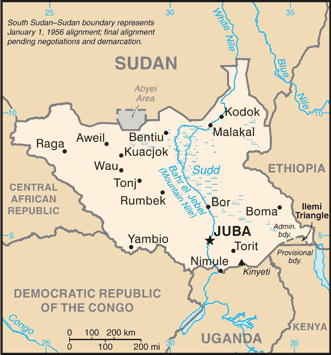
http://www.factsking.com/countries/south-sudan/
Tuesday, January 24, 2017
Danger of a Single Story
Chimamanda Ngozi’s TED Talk is an example of
her story about her encounters with others who had their own stories. She
covers the problems that happen when people have one story and one type of
story. She used so many example that explain how one story or experience you
have cannot be the only one you open your mind to. She explain the danger of
reading one type of book. How from those books she only believed that blond
haired, blue eyed, English people existed in stories. These stories closed her
mind to the many types of people there are as well as that there are more
people like her. This is something that took me almost to college to really
experience. I had two people of color in my entire high school, though I had
read and know of the many other cultures that exist, it wasn’t until college in
the south that I experience communities different then my own. This video was
another reminder to never use the experiences and stories I’ve heard to
categorize new people who I meet. This has been something I was able to start
practicing in college but something that I will continue as a teacher. Everyone
has their own story specific to them, No story I hear will be the same for
someone else. It is important that I understand that everyone student has their
own story. That I don’t assume something because how they look, how they talk,
or where they have come from. This topic is very similar to the discussion I
have in my anthropology course. We take a look into other cultures but we are
always reminded that no matter how much reading and studying you do there is no
way to understand a culture or someone’s life unless you are immersed in their
lifestyle and culture. It is important to know students have their own life
story but it is also important to teach them of other’s stories. So that they
are not closed minded by their own experience and they are aware of the dangers
of a single story.
Subscribe to:
Posts (Atom)